
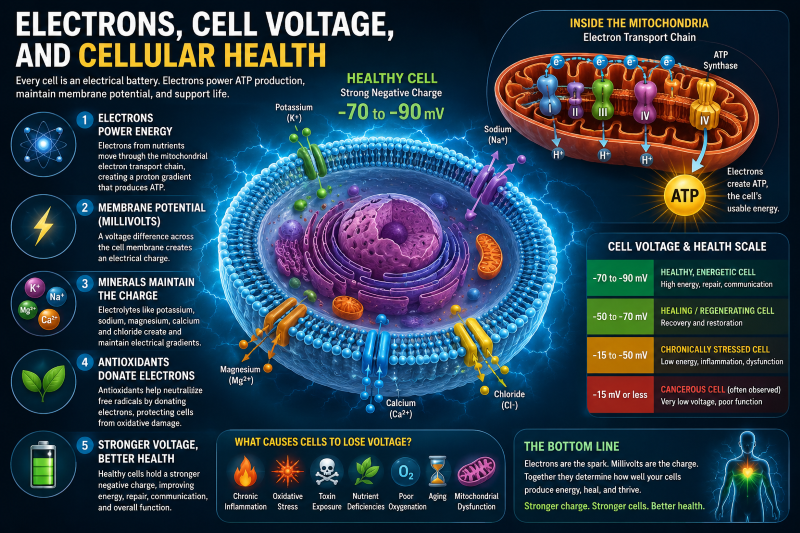
The relationship between electrons, a cell’s millivolt (mV) charge, and cellular health is one of the most fundamental aspects of biology.
1. Cells Run on Electrical Charge
Every living cell maintains an electrical voltage across its membrane, called the membrane potential. This voltage is measured in millivolts (mV).
| Cell State | Membrane Potential |
|---|---|
| Healthy, energetic cell | -70 to -90 mV |
| Healing or regenerating cell | -50 to -70 mV |
| Chronically stressed cell | -15 to -50 mV |
| Cancerous cell, often observed | -15 mV or less |
The negative sign means the inside of the cell contains more negative electrical charge relative to the outside.
2. Electrons Are the Basis of Cellular Energy
The body’s energy currency, ATP, is produced by moving electrons through the mitochondrial electron transport chain.
Electrons derived from food are passed through a series of protein complexes in the mitochondria:
- Food provides electrons
- Electrons help create a proton gradient
- The proton gradient helps produce ATP
Without proper electron flow:
- ATP production falls
- Cellular repair slows
- Detoxification declines
- Oxidative stress rises
3. Higher Negative Charge Generally Indicates Better Cellular Function
When cells maintain a strong negative membrane potential, they are often better able to perform essential functions.
- Nutrients enter more efficiently
- Waste products exit more efficiently
- Enzymes function more effectively
- Mitochondria produce ATP more efficiently
- Cell communication improves
A cell with a strong negative charge can be thought of as an energized cell.
4. What Causes Cells to Lose Voltage?
Several factors can reduce cellular voltage and weaken normal cellular function.
- Chronic inflammation
- Oxidative stress
- Mineral deficiencies
- Poor oxygenation
- Toxin exposure
- Aging
- Mitochondrial dysfunction
As electron balance declines and membrane potential weakens, the cell becomes less efficient.
5. Minerals Help Maintain the Charge
Electrolytes help create and maintain membrane voltage. These minerals allow cells to generate electrical gradients.
- Potassium, mainly inside cells
- Sodium, mainly outside cells
- Magnesium
- Calcium
- Chloride
Potassium is especially important for the resting membrane potential of many cells.
6. Antioxidants Are Electron Donors
Many antioxidants work by donating electrons. When free radicals steal electrons from cells, antioxidants can help neutralize them.
Examples of electron-donating antioxidants include:
- Whole complex Vitamin C
- Polyphenols
- Anthocyanins
- Compounds in Nigella sativa
- Flavonoids from fruits and herbs
7. Grounding and Electron Theories
Some researchers have proposed that direct contact with the Earth may allow the body to absorb free electrons from the ground. This is often discussed in the context of grounding or earthing.
Some studies suggest possible effects on inflammation and stress markers, but the overall scientific evidence is still limited and debated.
A Simple Analogy
Think of a cell like a rechargeable battery:
- Electrons are like electrical current
- Millivolt charge is like battery voltage
- ATP is the usable energy produced by the battery
A healthy cell is like a fully charged battery, often around -70 to -90 mV.
A stressed or poorly functioning cell is like a battery running low, often showing a weaker electrical potential.
Conclusion
The cell’s ability to hold and manage electrical charge is closely connected to energy production, repair, detoxification, and overall health. Electrons fuel mitochondrial ATP production, while minerals help maintain the electrical gradients that allow cells to function properly.
From a biochemical perspective, good nutrition, adequate minerals, oxygen, healthy mitochondria, and protection from excessive oxidative stress all help cells maintain their electrical potential and overall vitality.
